
Quick answer: what should you budget?
For early planning, Austin cabinet-painting guides commonly show approximately $1,500–$6,000 for professional projects, with smaller jobs near the lower end and larger kitchens, detailed doors, extensive preparation, or premium finish systems near the higher end. Some published guides use linear-foot pricing around $30–$60 per linear foot; others price by door, drawer, or complete scope.
Those numbers are useful for orientation, not a promise. Two kitchens with the same number of cabinets can require very different labor if one has a clean, sound surface and the other has grease, peeling coating, worn edges, repairs, or a difficult layout.
What determines kitchen cabinet painting cost in Austin?
Number of doors and drawers
More removable pieces mean more labeling, edges, surfaces, drying space, and reinstallation time.
Cabinet condition
Grease, stains, worn finish, peeling, dents, loose joints, and damaged edges add preparation or repair work.
Material and old coating
Solid wood, veneer, MDF, laminate, and previously varnished surfaces may need different primers and adhesion tests.
Color change
Dark wood or a strong existing color may need extra primer or finish coats to produce an even lighter result.
Finish and application
Brush, roller, or spray application affects masking, setup, texture, labor, and the appearance homeowners expect.
Hardware and scope
Keeping, replacing, filling old holes, or relocating knobs and pulls can change both labor and material requirements.
Example: a cabinet transformation from dark to light
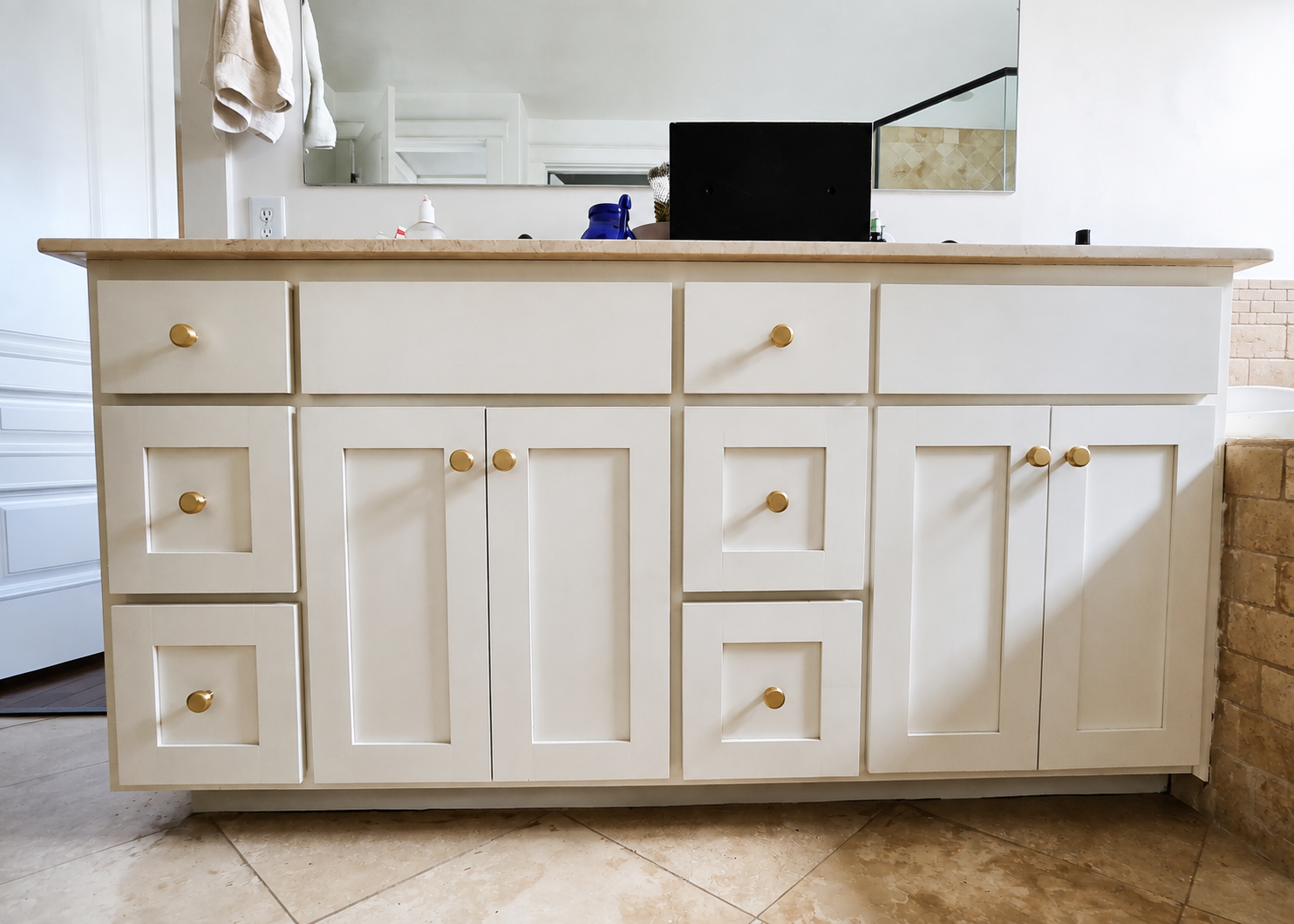
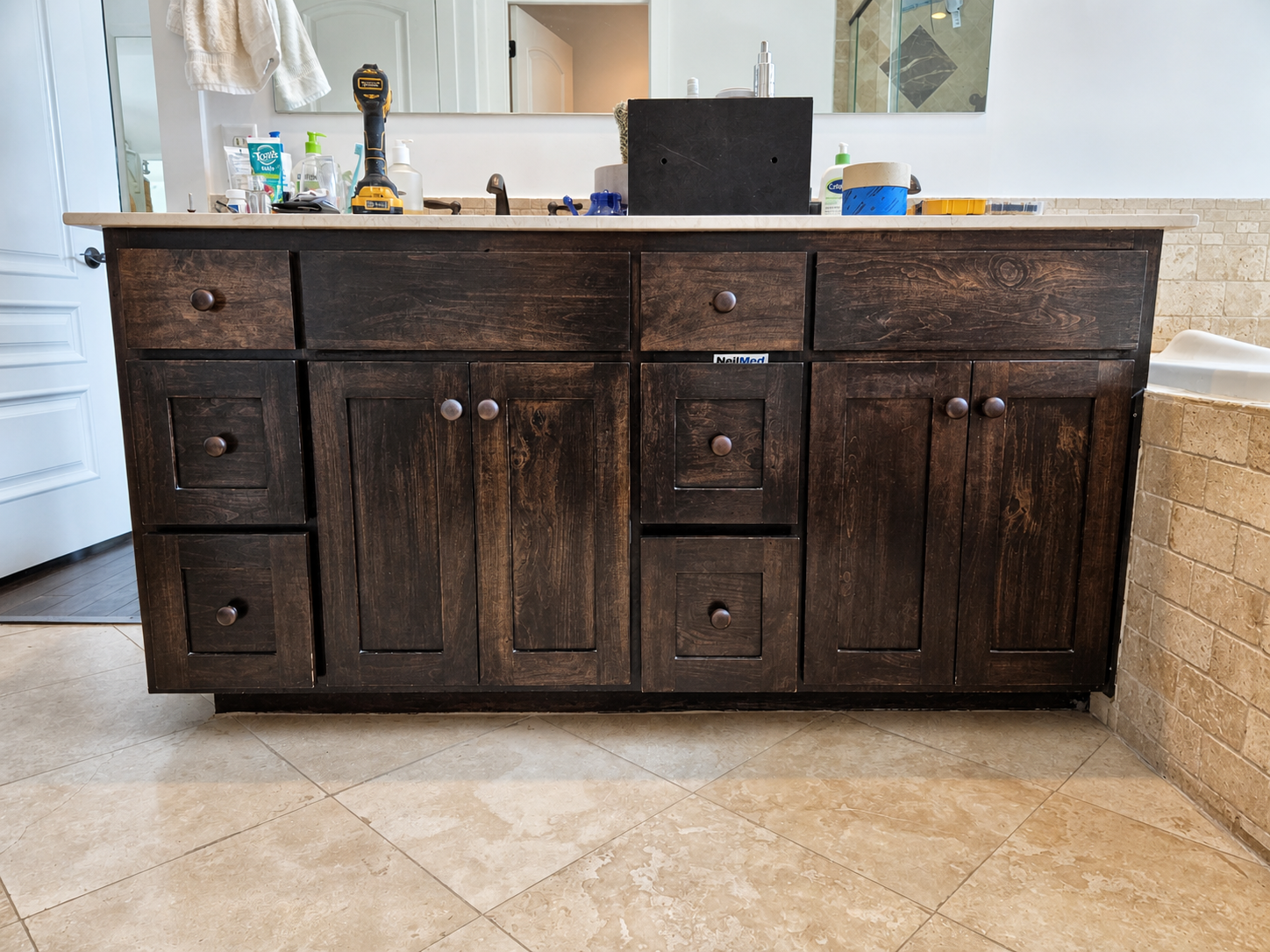
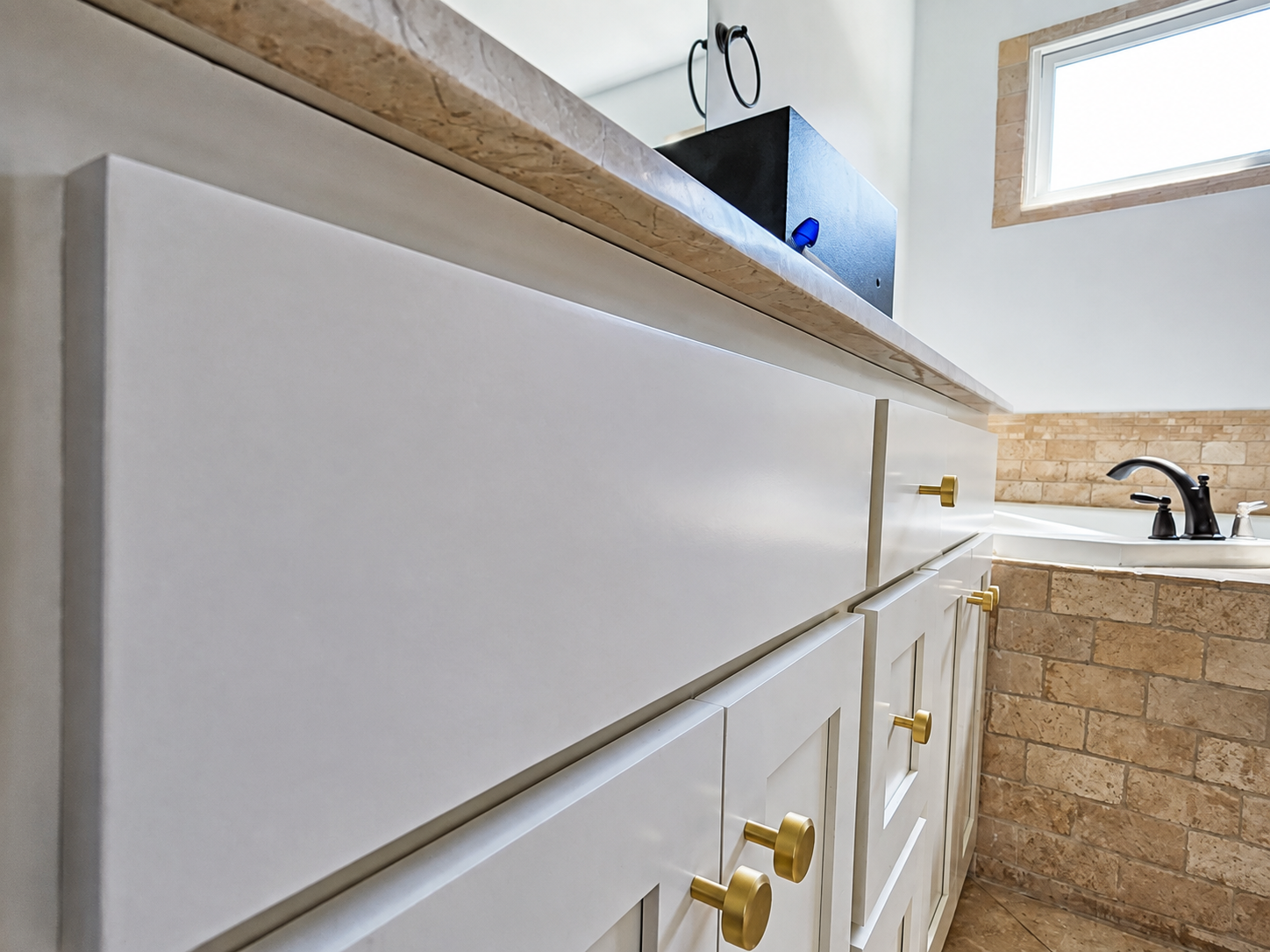
In this project, the original vanity had a dark stained appearance with visible grain and everyday wear. The finished result used a light color and contrasting gold hardware, creating a cleaner and brighter look while keeping the existing cabinet layout and countertop.
This kind of transformation is why painting can be attractive: the homeowner changes the visible finish without paying for new boxes, new countertop work, demolition, and a completely new layout. It still requires careful preparation because a light, smooth finish makes defects easier to see.
What preparation should a professional include?
A durable cabinet finish begins with a clean, sound, dull surface. Depending on the project, preparation may include:
- Removing doors, drawer fronts, knobs, and pulls.
- Labeling pieces so everything returns to its original location.
- Cleaning and degreasing cooking residue, oils, dust, and cleaning-product buildup.
- Repairing small dents, chips, open seams, and unwanted hardware holes.
- Scuff sanding or deglossing the existing finish as appropriate.
- Testing primer adhesion on the actual cabinet material.
- Spot-priming or priming the surfaces when the product system requires it.
- Protecting countertops, floors, appliances, walls, and the work area.
- Applying the cabinet coating in controlled coats and allowing proper dry or cure time.
- Inspecting, touching up, and reinstalling the doors and hardware.
Sherwin-Williams recommends removing doors and hardware, cleaning with a degreaser, testing adhesion, smoothing the primer, and removing dust before the first finish coat. Benjamin Moore likewise emphasizes product-specific preparation for previously coated wood and laminate. The exact system should follow the selected product’s technical instructions.
How much paint is needed for cabinets?
Cabinet projects usually do not consume as much paint as painting a whole room, but the surface area is broken into many edges, profiles, door backs, drawer fronts, and cabinet frames. A typical gallon may cover roughly 350–400 sq ft depending on the product and surface, yet actual use can be higher because of multiple coats, primer, spray setup, and material left in tools.
Material cost is only one part of the estimate. Labor for removing, preparing, coating, drying, protecting, and reinstalling the pieces is usually the larger part of a cabinet project. That is why “a gallon of paint” is not a meaningful complete price for a kitchen.
Painting cabinets vs. replacing cabinets
| Painting existing cabinets | Replacing cabinets |
|---|---|
| Keeps the existing layout and cabinet boxes | Allows a new layout, sizes, and storage plan |
| Usually less demolition and disruption | Includes removal, disposal, delivery, and installation |
| Works best when boxes and doors are structurally sound | May be appropriate for severe damage or poor layout |
| Changes color and finish without replacing everything | Can change material, door style, interiors, and accessories |
Painting is not a solution for cabinets with serious water damage, failing construction, or a layout that no longer works. During an estimate, it is worth discussing whether refinishing the existing pieces will solve the homeowner’s actual problem.
Choosing a cabinet finish for an Austin home
Kitchens and bathrooms need a coating that can handle regular cleaning and everyday contact. Satin and semi-gloss finishes are common considerations because they offer a balance between cleanability and the visibility of surface imperfections. A very glossy finish can show more preparation flaws, while a flatter finish may be less practical for frequently touched cabinet surfaces.
The right product depends on the substrate, existing finish, color, application method, and the manufacturer’s instructions. VAM Services LLC can discuss the options during the estimate and recommend a finish appropriate for the project rather than treating every cabinet as the same.
What should be listed in the cabinet painting estimate?
- Number of doors, drawer fronts, frames, and exposed end panels.
- Whether cabinet interiors, shelves, toe-kicks, and sides are included.
- Cleaning, sanding, repairs, primer, and adhesion testing.
- Paint or enamel product, color, sheen, and expected coats.
- Spray-area setup, masking, ventilation, and protection.
- Hardware removal, replacement, hole filling, and reinstallation.
- Drying or curing assumptions, touch-ups, cleanup, exclusions, and schedule.
A detailed scope protects both the homeowner and the contractor. It also makes estimates easier to compare because one proposal may include only the doors while another includes doors, frames, sides, shelves, and the full preparation process.
Get a cabinet painting estimate in Austin
Send the property address, photos of the cabinets, approximate number of doors and drawers, current finish, preferred color, hardware plans, and any visible damage. Mention whether this is a kitchen, bathroom vanity, laundry room, built-in, or another cabinet project.
VAM Services LLC provides cabinet painting as part of its painting and home improvement services in Austin and nearby communities. Request a Free Estimate to review the surfaces, preparation, finish, and project scope.
Frequently asked questions
- How much does it cost to paint kitchen cabinets in Austin, TX?
- Published Austin pricing guides show broad ranges from about $1,500 to $6,000 or more, depending on the number of doors and drawers, cabinet condition, layout, preparation, paint system, and hardware. A simple vanity or small cabinet project will cost less than a full kitchen with many pieces. These are planning ranges, not a VAM Services LLC quote.
- Is painting cabinets cheaper than replacing them?
- Usually, painting or refinishing sound cabinet boxes is less expensive than full replacement because the existing layout and structure remain. Replacement may make more sense when cabinets have serious water damage, failing construction, poor layout, or widespread rot.
- What preparation is needed before cabinet painting?
- Professional preparation commonly includes removing and labeling doors and hardware, degreasing, repairing small defects, scuff sanding or deglossing, priming when needed, protecting the room, and testing adhesion. The exact process depends on whether the cabinets are wood, veneer, laminate, MDF, or previously coated.
- What paint finish is best for kitchen cabinets?
- A durable cabinet or trim enamel in a suitable satin or semi-gloss sheen is commonly considered for cabinets because it balances cleanability and appearance. The correct product depends on the substrate, existing coating, desired sheen, application method, and manufacturer instructions.
- How long does cabinet painting take?
- A professional cabinet project often takes several days because doors need to be removed, prepared, coated, dried or cured, and reinstalled. Larger kitchens, detailed doors, repairs, color changes, and on-site masking can extend the schedule.