
Quick answer: what should you budget?
Our Austin interior painting cost guide explains a broad third-party range of approximately $2–$6 per square foot of home floor area. Applying that one method to a 2,000 sq ft home produces a broad planning range of $4,000–$12,000.
That calculation is not a VAM Services LLC quote. It is only a first planning reference. The more useful question is: how many square feet will actually be painted, how many coats are needed, and what preparation comes first?
How much wall area is in a 2,000 sq ft house?
There is no universal wall-area standard for a home based only on floor area. A 2,000 sq ft open-plan home has fewer wall surfaces than a home divided into four bedrooms, several bathrooms, hallways, closets, and utility spaces. Eight-foot ceilings and nine-foot ceilings also produce different totals.
For a practical planning model, assume a one- or two-story home with about 2,000 sq ft of floor area, 8–9 ft ceilings, three or four bedrooms, interior hallways, closets, and normal partitions. Measuring the room perimeters and counting both sides of shared partitions gives a reasonable gross range of approximately 5,500–7,500 sq ft of interior walls.
That is a planning range, not a measurement of a specific Austin house. Doors, windows, large openings, and areas not included in the contract are then deducted. A realistic net wall-painting area might land around 4,800–6,800 sq ft, depending on the number and size of openings.
A simple way to understand the estimate
- Break the home into rooms, hallways, closets, and other spaces.
- For each space, add the wall lengths and multiply by the ceiling height.
- Include both sides of interior partitions when both rooms are being painted.
- Subtract doors, windows, large openings, and excluded surfaces.
- Keep ceilings, trim, doors, and cabinets as separate line items.
How many gallons of paint might the walls require?
Paint manufacturers commonly use coverage around 350–400 sq ft per gallon for a smooth surface. Sherwin-Williams gives a typical range of 350–400 sq ft per gallon and explains that 400 sq ft is theoretical because texture, porosity, application method, and material left in tools affect actual yield. A Benjamin Moore Regal Select interior product lists 400–450 sq ft per gallon, with one or two recommended coats depending on the product and surface.
Using the conservative planning figure of 400 sq ft per gallon for one coat:
| Wall area | One coat | Two coats |
|---|---|---|
| 4,800 sq ft net | About 12 gallons | About 24 gallons |
| 6,800 sq ft net | About 17 gallons | About 34 gallons |
| 5,500–7,500 sq ft gross | About 14–19 gallons before deductions | About 28–38 gallons before deductions |
These figures describe wall paint only. Ceilings add roughly another 2,000 sq ft in a simple home—about 5 gallons per coat at 400 sq ft per gallon. Trim, baseboards, doors, closets, accent colors, primer, and touch-ups should be estimated separately. Rough, porous, patched, or strongly color-changing surfaces may use more material.
For the product-specific guidance, see Sherwin-Williams paint coverage guidance and the Benjamin Moore Regal Select product information. Always check the technical data or label for the exact paint selected.
Why two 2,000 sq ft homes can have different prices
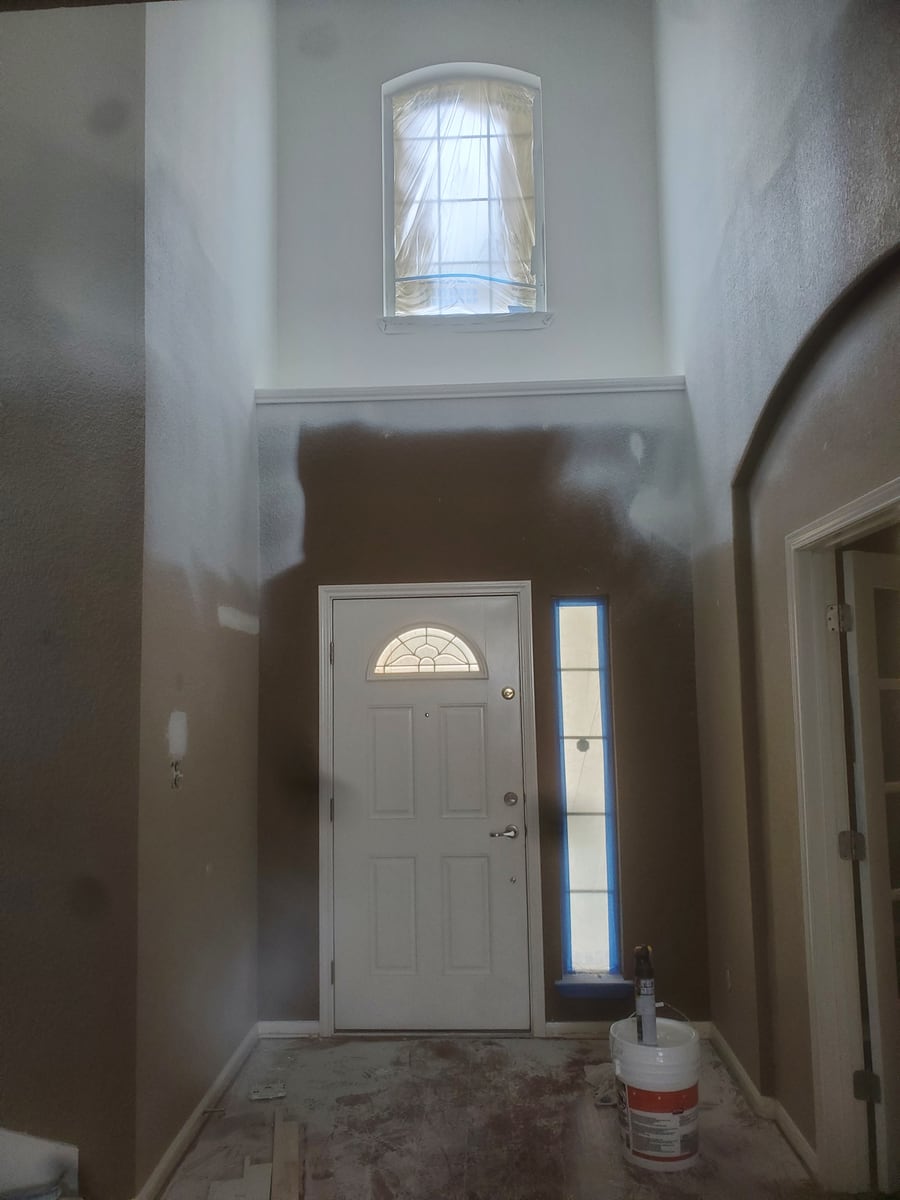
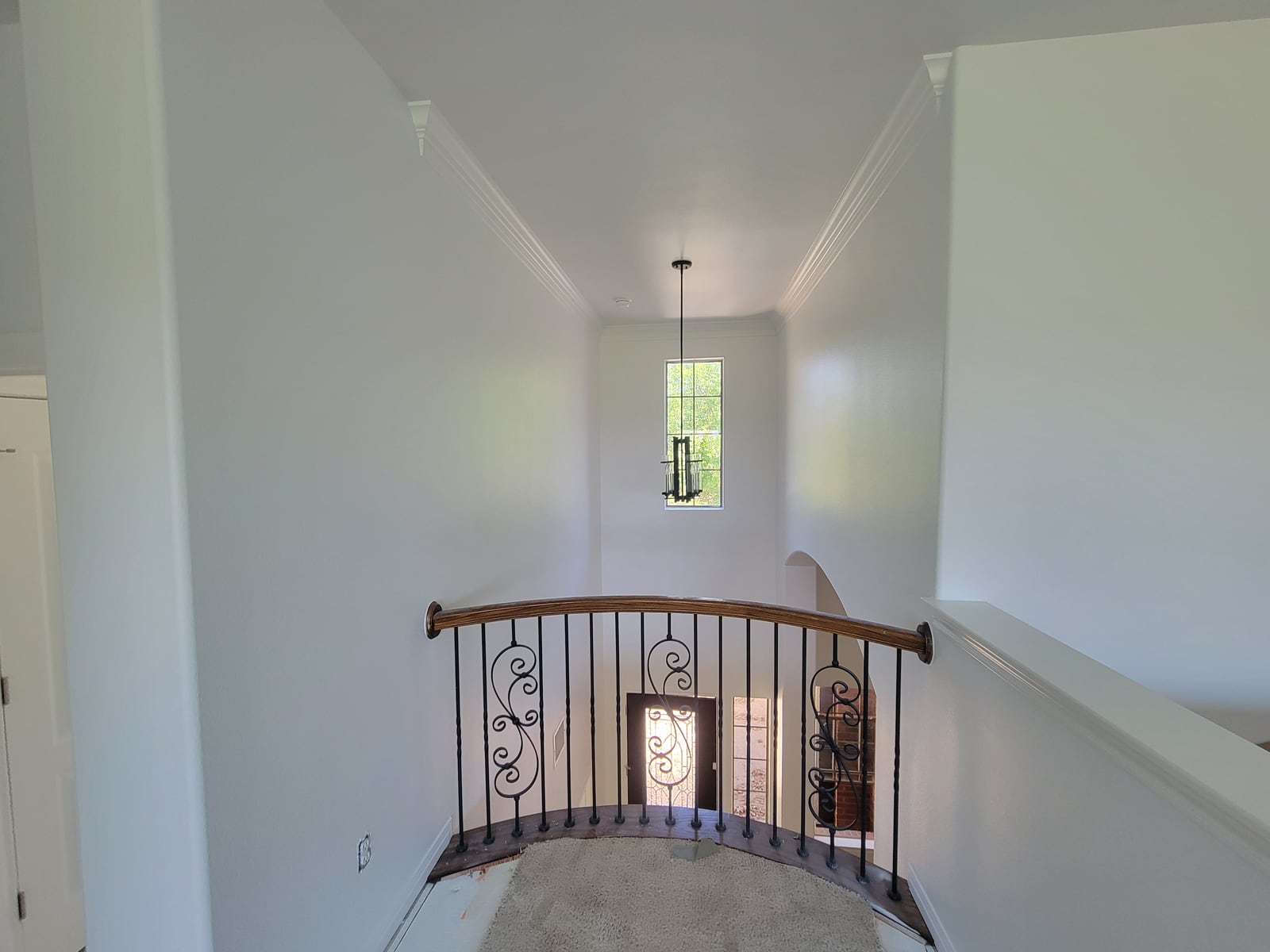
Floor area does not show how much work is required. A one-story home with open rooms, good walls, and one consistent color can be very different from a two-story home with tall walls, stairwells, dark-to-light color changes, damaged drywall, and detailed trim.
Surfaces included
Walls only cost less than walls plus ceilings, doors, baseboards, casing, closets, built-ins, or cabinets.
Preparation
Cleaning, caulking, sanding, patching, priming, and drywall repair add labor before finish coats begin.
Access and height
Vaulted ceilings, stairwells, narrow areas, and high walls can require more setup, ladders, or specialized access.
Furniture and occupancy
Moving and protecting furniture, floors, fixtures, and belongings takes more time in an occupied home.
What preparation should happen before painting?
A good finish starts before the first gallon is opened. The preparation plan for a 2,000 sq ft home may include:
- confirming the surfaces and colors included in the scope;
- moving, covering, and protecting furniture, flooring, fixtures, and countertops;
- removing dust, grease, cobwebs, and other contaminants;
- scraping loose coating and dulling glossy areas where needed;
- filling nail holes, dents, cracks, and drywall damage;
- caulking gaps at trim and transitions when appropriate;
- sanding repairs smooth and removing dust;
- spot-priming stains, bare drywall, patched areas, or surfaces that need better adhesion;
- masking edges and protecting hardware before rolling or brushing;
- checking the first coat before deciding whether a second coat is needed.
Preparation is not wasted time. It controls flashing, uneven sheen, visible patches, peeling, rough texture, and premature failure. If the home has larger holes, water damage, loose tape, or texture differences, ask whether the work belongs in a separate drywall repair scope.
What a 2,000 sq ft painting estimate should break out
- Rooms and surfaces: walls, ceilings, trim, doors, closets, and other areas included.
- Preparation: cleaning, patching, caulk, sanding, primer, drywall work, and texture matching.
- Paint system: product level, color count, sheen, and expected number of coats.
- Protection and access: furniture moving, floor protection, masking, ladders, and staging.
- Completion details: cleanup, touch-ups, exclusions, schedule assumptions, and payment terms.
A clear scope helps homeowners compare estimates fairly. A lower number may simply exclude ceilings, trim, repairs, paint, or furniture protection.
Scope matters more than the square-foot label
| Scope | Main cost drivers | Why it differs |
|---|---|---|
| Selected-room walls | Limited rooms, normal access, light preparation | Less surface area and setup than a whole-home repaint |
| Whole-home walls | More rooms, protection, color changes, repairs | Layout, occupancy, and wall condition affect labor |
| Walls, ceilings, trim, and doors | Extra masking, detail work, access, and finish requirements | More surfaces and preparation than walls alone |
These are scope comparisons, not fixed pricing tiers. The right estimate comes from seeing the home and confirming what “paint the house” means for that project.
What about drywall damage before painting?
Small nail holes and minor dents may be ordinary preparation, but cracks, water damage, loose tape, large holes, skim coating, and texture matching can change price and schedule. Ask whether drywall work is included, excluded, or priced separately.
VAM Services LLC also provides drywall repair services when the surface needs more than basic painting preparation.
How to get an accurate estimate for your Austin home
Gather the address, approximate floor area, rooms and surfaces, wall condition, preferred colors, occupancy status, timing, and photos if available. Mention high ceilings, stairwells, built-ins, water stains, or previous repairs.
VAM Services LLC provides free estimates for homeowners in Austin and nearby service areas. Request a Free Estimate to discuss the actual scope of your 2,000 sq ft home.
Frequently asked questions
- How much does it cost to paint a 2,000 sq ft house in Austin?
- A broad third-party planning range discussed in our Austin interior painting cost guide works out to approximately $4,000–$12,000 when multiplied by 2,000 sq ft of floor area. This is not a VAM Services LLC quote; the actual scope, preparation, surfaces, access, and products determine the estimate.
- Does 2,000 sq ft mean 2,000 sq ft of paintable surface?
- No. The home size is floor area. Paintable wall area changes with room layout, ceiling height, doors, windows, closets, ceilings, trim, and the surfaces included in the project.
- Is it cheaper to paint an empty 2,000 sq ft house?
- Usually, an empty or mostly empty home allows easier access and less furniture protection. A furnished home can be painted safely, but moving, covering, and protecting belongings adds time to the scope.
- Should drywall repairs be included in the painting estimate?
- Small nail holes and ordinary patching may be part of preparation, but larger damage, skim coating, cracks, and texture matching should be identified separately so the scope is clear.